Case Study
SovaService Operations + Field Operations
The operating system behind every clean.
The challenge
A reliable cleaning service needs more than a booking app.
Once a customer books, the hard part moves into operations: building realistic schedules, assigning the right team, handling delays, and recovering when a job changes.
The product challenge was to give operators the visibility and control to keep the day moving, while giving field teams only the information they need to execute the work.
Realistic schedules
Clear ownership
Visible risk
Fast recovery
Product model
One service record, carried across three layers.
The customer experience, service operations layer, and field tool are separate interfaces built around the same underlying work. Each layer answers a different operational question.
What needs to happen?
Property, service, timing, payment, and booking context.
How do we deliver it?
Scheduling, assignment, dispatch, quality, and recovery.
What happens now?
Location, scope, execution, issues, and completion.
Service Operations
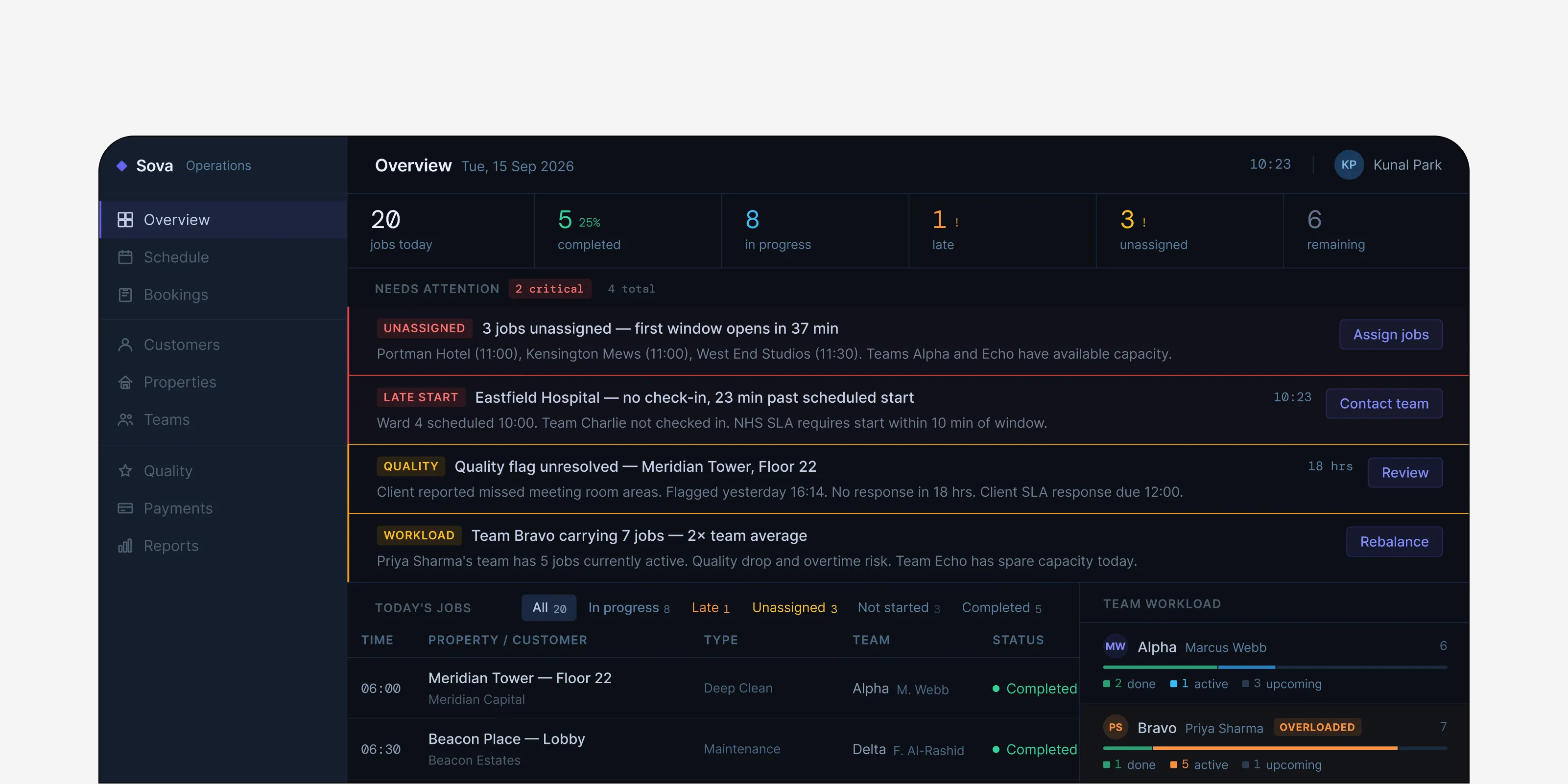
Run the day from one operational view.
The operations workspace turns bookings, people, timing, and risk into one shared picture of the day. Operators can see what needs attention before deciding what to do.
Operational risk
Detect the jobs that may not make the plan.
A schedule can look valid on paper and still fail in the real world. Travel time, overruns, buffers, workload, and geography all affect whether the next job is actually reachable.
Shared record
One job, one source of truth.
The detail page is the canonical service record. Customer context, service scope, assignment, status, and recovery information stay connected instead of fragmenting across tools.
Team management
Manage people as part of the service system.
Operators need to understand teams as delivery capacity, not just as a directory of workers. Team-level and person-level context make assignment and intervention more deliberate.
Quality + recovery
Recovery is part of the product, not an exception to it.
Service quality inevitably creates follow-up work. The system makes that work visible, keeps the original job context attached, and gives operators a path from issue to resolution.
Supporting views
The operating model extends beyond the schedule.
Bookings, customers, properties, and risk states connect back to the same service model, giving operators multiple ways to move through the work without breaking context.
Field Operations
Execution should be lighter than operations.
Field workers do not need a dashboard. They need to know where to go, what the job includes, what changed, and what to do next.
Know the job
Start the work
Handle exceptions
Complete the service
The field layer strips the wider operating model down to the information required to do the work.
Offline resilience
Field work cannot depend on a perfect connection. When the network drops, actions remain available locally and sync when connectivity returns, while the interface makes the temporary status gap visible.
Connected service
The same service moves through the whole system.
The customer should not need to know how operations work. The operator should not need to reconstruct the customer context. The field worker should not need to interpret a complex scheduling system.
Book
Create the service request and its reusable context.
Coordinate
Schedule, assign, monitor, and recover the work.
Execute
Deliver the service and report what happened.
Design principles
Make operational complexity useful, not overwhelming.
See the system
Make the state of the operation visible before asking for action.
Surface risk
Highlight issues that need attention before they become failures.
Preserve context
Keep the same service record connected across every layer.
Simplify execution
Give field teams only the information required to do the work.
Reflection
Good operational UX makes complexity visible to the right people.
The strongest decisions came from separating the needs of the operator from the needs of the field worker while keeping both connected to the same service record. The operation can remain sophisticated underneath without making every interface sophisticated on the surface.