Case Study
SovaHome Cleaning Experience
Making professional home cleaning effortless to book and manage.
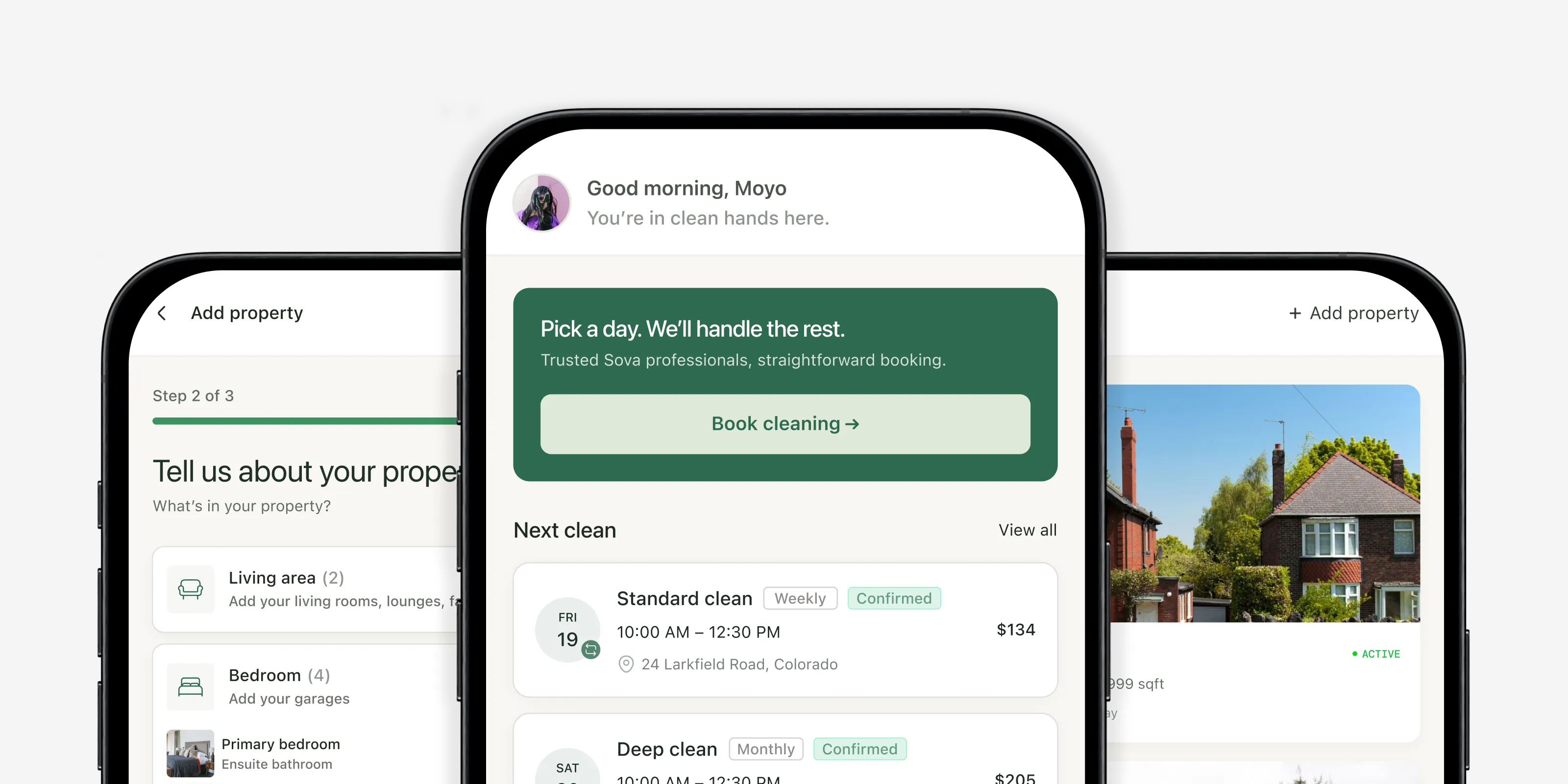
01 · Acquisition
The experience starts before the app.
Before a customer can book a cleaning, they need a clear reason to choose Sova and a simple path into the app.
The acquisition landing page acts as that bridge. It introduces the service, explains the value of the app, and moves the customer toward booking without asking them to understand how Sova operates.
The challenge
Booking a cleaning involves more decisions than it should.
A cleaning booking can involve property information, service selection, scope, timing, payment, and follow-up.
The product challenge was not simply to reduce the number of screens. It was to make the underlying service complexity feel simple to the customer while still capturing the structure Sova needs to deliver the work.
Less coordination — Customers should choose what they need without managing the cleaner or operational schedule.
Reusable context — Property information should be captured once and reused across future bookings.
Clear decisions — Each step should make the next decision obvious without overwhelming the customer.
Flexible service — Changes to a booking should not break the underlying property or recurring service structure.
The product model
Discover → Set up → Book → Confirm → Manage
The customer journey moves from understanding Sova to setting up the home, booking a service, and managing what happens next.
Discover
Understand what Sova provides and why the app is useful.
Set up
Create a reusable property and describe the home once.
Book
Choose the service, day, time window, and scope.
Confirm
Review the complete booking before payment.
Manage
View the service, make changes, and manage recurring cleaning.
02 · Property model
A property is more than an address.
Sova treats the property as a reusable part of the customer relationship. The same home can support multiple bookings without forcing the customer to start from scratch.
Reusable context — Property details stay attached to the property rather than being recreated inside each booking.
Multiple properties — One customer account can support more than one home or managed property.
Service history — The property's relationship with Sova can continue across previous and upcoming cleanings.
Customer control — Property information remains editable without confusing it with an individual booking.
03 · Property setup
Capture the home once without making customers manage it.
Sova needs structured information about the home, but the customer should not have to think like an operations team. Spaces make the structure explicit while keeping the setup focused.
Structured spaces — Bedrooms, living areas, bathrooms, and kitchen are treated as meaningful parts of the property.
Progressive detail — Room-level information appears when it is relevant rather than turning the initial setup into a long form.
Optional photos — Photos can help the team understand the property without making image capture mandatory.
Review before saving — The customer gets a final view of the property structure before continuing.
04 · Booking
Book the service, not the cleaner.
Customers choose what they need and when it works for them. Sova handles the operational coordination behind that choice.
Service-led choice — Customers select the cleaning service rather than navigating individual cleaners or operational availability.
Context stays attached — The selected property remains part of the booking as the customer moves forward.
No operational burden — The interface does not expose assignment or dispatch decisions that Sova handles internally.
Clear progression — Each step prepares the information needed for the next one.
05 · Scheduling
Let customers choose when works without asking them to coordinate availability.
Day first — Customers establish the preferred date before considering the available time windows.
Time windows — The experience gives customers a practical arrival window rather than forcing them to manage an exact cleaner schedule.
Operational flexibility — Sova retains the flexibility needed to coordinate the actual service behind the scenes.
Recurring path — Regular cleaning can be introduced without creating a separate booking system.
06 · Review + payment
Make the final decision easy to verify.
The review step brings the important booking information together before the customer commits.
One decision surface — Property, service, scope, add-ons, schedule, and price are brought together before payment.
Confidence before commitment — Customers can review the complete service instead of relying on information spread across earlier steps.
Clear completion — Booking confirmation closes the transaction and establishes the next state.
No hidden complexity — The interface communicates what the customer is buying without exposing the operational work behind it.
07 · Post-booking
The relationship continues after payment.
Booking is not the end of the experience. Customers still need to understand what is happening and manage upcoming service when plans change.
Booking context — The booking detail keeps the important service information together after confirmation.
Ongoing control — Upcoming bookings remain manageable rather than becoming static records.
History — Previous cleanings remain part of the customer's service relationship with Sova.
Home base — The broader home experience keeps current activity and properties accessible between bookings.
08 · Designing for change
A cleaning booking needs to remain flexible.
Scope, add-ons, and recurring service can change independently. The product treats those changes as normal parts of managing the service rather than exceptions.
Property stays separate — Changing what gets cleaned does not change what exists in the customer's home.
Scoped changes — Customers can choose whether a change applies to the current cleaning or future cleanings.
Independent add-ons — Additional services can follow their own cadence within a recurring cleaning relationship.
Reversible by design — Changes are made explicitly so recurring rules are not changed accidentally.
The connected service
The interface stays simple because the system handles the complexity.
The customer experience is connected to the wider Sova service model. Property and booking information is designed to move into operations and field execution without asking the customer to understand those layers.
Customer app — Captures the property, booking, preferences, and changes.
Operations — Uses the booking context to schedule, assign, and coordinate the service.
Field execution — Gives the assigned team the information required to complete the job.
Customer
What do I need?
Property, service, timing, payment, and booking control.
Operations
How do we deliver it?
Scheduling, assignment, dispatch, quality, and recovery.
Field
What do I do now?
Location, job scope, execution, issues, and completion.
Design principles
Keep the customer focused on the service, not the system.
Reuse
Capture property context once and reuse it.
Simplify
Keep operational complexity behind the interface.
Connect
Carry useful context across the service journey.
Adapt
Let bookings change without breaking the system.
Reflection
A simple booking experience is built on a structured service model.
The strongest design decisions came from separating what the customer needs to decide from what Sova needs to manage. Property structure, booking scope, recurring rules, and operational coordination can remain complex underneath while the customer experience stays direct.